Tell us about the job
Takes about a minute. No obligation.
A contractor quoting boiler installation in Gallatin County has to solve a local problem, not a generic one: how the structure is built, how it loses heat, and what a replacement system has to do to cover it. 40 severe weather events were recorded in Gallatin County, Kentucky between 2015 and 2024. At that rate, severe weather is an event here rather than a routine operating load, which means a struggling boiler is far more likely carrying the cost of age or an undersized original install than storm wear. That shifts what sizing decisions are based on, and a contractor who skips a proper heat-loss assessment before specifying equipment is skipping the only calculation that actually fits the house.
Existing ductwork in a house this age was laid out for a different generation of equipment, and whether it can carry a new boiler system is the question that shapes the whole job. Half the homes in Gallatin County, Kentucky were built in 1993 or earlier (2020-2024 ACS 5-year). A contractor opening up those runs checks dimensions, condition, and routing before anything else gets priced, because a duct system that was right for what the house originally held may need alteration to move heat the way a new boiler distributes it. The electrical is a separate check. Both have to be settled before the equipment selection means much.
What Gets Installed With a New Boiler
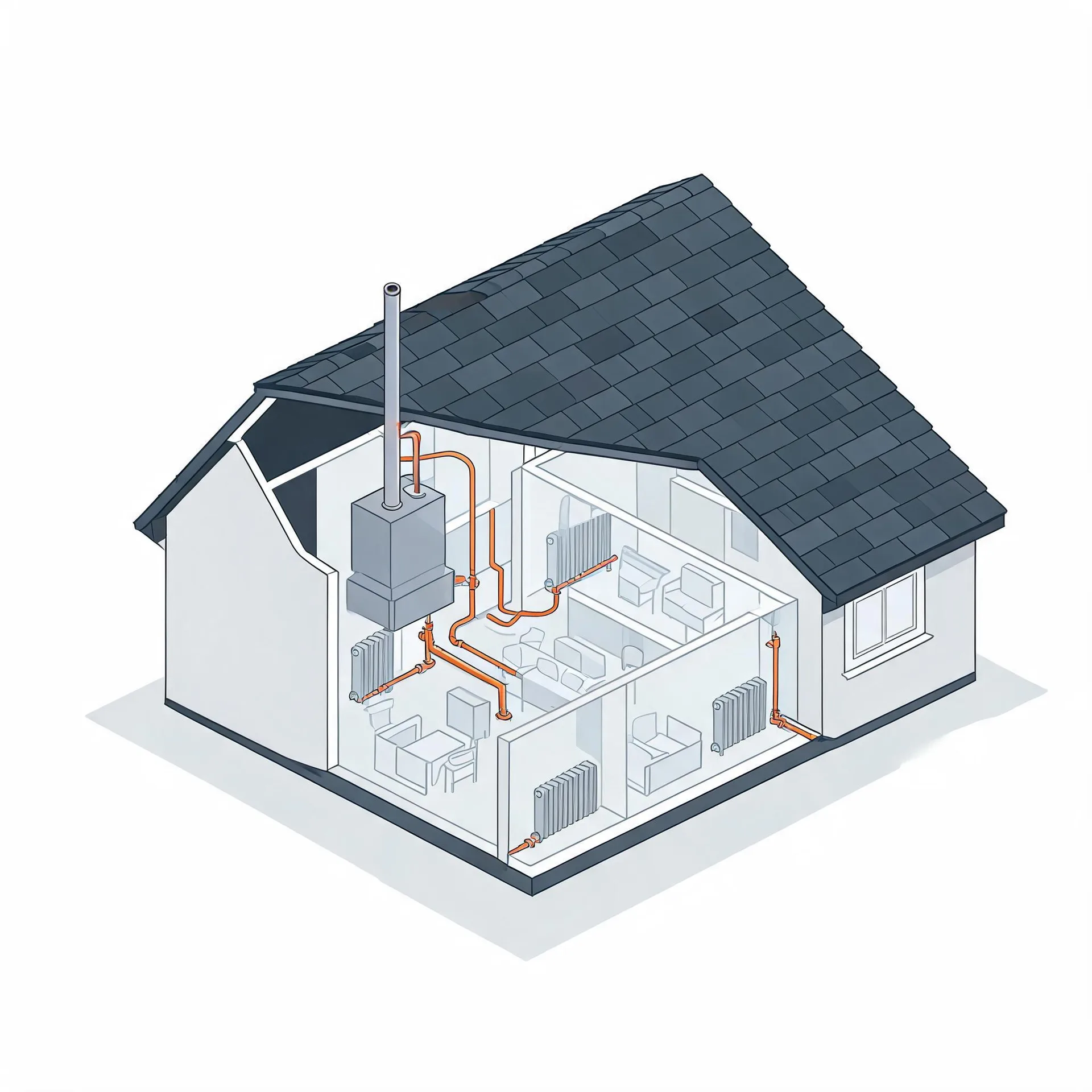
The boiler itself sits in a mechanical room, basement, or utility closet and is the unit that heats water for the whole system. Attached to it are the supply and return piping, which carry hot water out to the living spaces and bring cooler water back. The expansion tank mounts nearby and absorbs pressure changes as water heats up.
Radiators or baseboard convectors sit along exterior walls or beneath windows in each room, releasing heat into the space. The circulator pump, mounted close to the boiler, keeps water moving through the loop. A thermostat on an interior wall ties the whole system together and tells the boiler when to fire.
The drawing here shows a typical layout, and a licensed contractor will assess what applies to your specific home and its existing conditions.
Get matched in Gallatin CountyGallatin County, by the numbers
40 severe weather events were recorded in Gallatin County, Kentucky between 2015 and 2024.
NOAA National Centers for Environmental Information, Storm Events Database, bulk CSV export, events 2015-01-01 through 2024-12-31.Half the homes in Gallatin County, Kentucky were built in 1993 or earlier (2020-2024 ACS 5-year).
U.S. Census Bureau, 2020-2024 American Community Survey 5-Year EstimatesGallatin County, Kentucky holds 3,816 housing units (2020-2024 ACS 5-year).
U.S. Census Bureau, 2020-2024 American Community Survey 5-Year EstimatesOwners occupy 75.1% of the occupied homes in Gallatin County, Kentucky (2020-2024 ACS 5-year).
U.S. Census Bureau, 2020-2024 American Community Survey 5-Year EstimatesBoiler Installation Rules for Gallatin County, Kentucky1 sourced standards and codes
Licensing and Legal Requirements in Gallatin County, Kentucky
Kentucky requires a licence to practise heating, ventilation and air conditioning contracting: a person may not do the work unless they have met the state licensing requirements.
Severe Weather Events in Gallatin County
Boilers in Gallatin County work against whatever the local climate demands, and that demand shifts with the weather this area actually sees. How hard a boiler is pushed over its life has a lot to do with what rolls through.
40 severe weather events, 2015–2024. Source: NOAA National Centers for Environmental Information, Storm Events Database.