Tell us about the job
Takes about a minute. No obligation.

Sizing a boiler for a Marion County home starts with what the local climate actually demands of a heating system, and the weather record here gives a contractor a clear frame for that decision. 74 severe weather events were recorded in Marion County, Kentucky between 2015 and 2024. At roughly the thirty-fifth percentile nationally, this county sits in the lower third of severe weather exposure, which means a contractor cannot point to an unusually punishing climate when a system underperforms. What that leaves on the table is installation quality, correct sizing for the structure, and component selection suited to the load this area does place on equipment. A boiler that is undersized or poorly fitted will struggle here for reasons a good install would have prevented.
Older ductwork and piping were sized for the equipment of their era, and what a contractor finds when they trace the existing runs through a Marion County home shapes the whole installation scope. Half the homes in Marion County, Kentucky were built in 1984 or earlier (2020-2024 ACS 5-year). A house built that long ago likely has distribution infrastructure that was configured around whatever heated it first, which a new boiler does not automatically inherit. Before a single component is priced, a contractor works out whether the existing pipe runs, radiators, or ducted returns will carry the output of a modern unit without modification. That assessment drives the quote more than the boiler itself does.
What a Boiler Installation Puts in Your Home
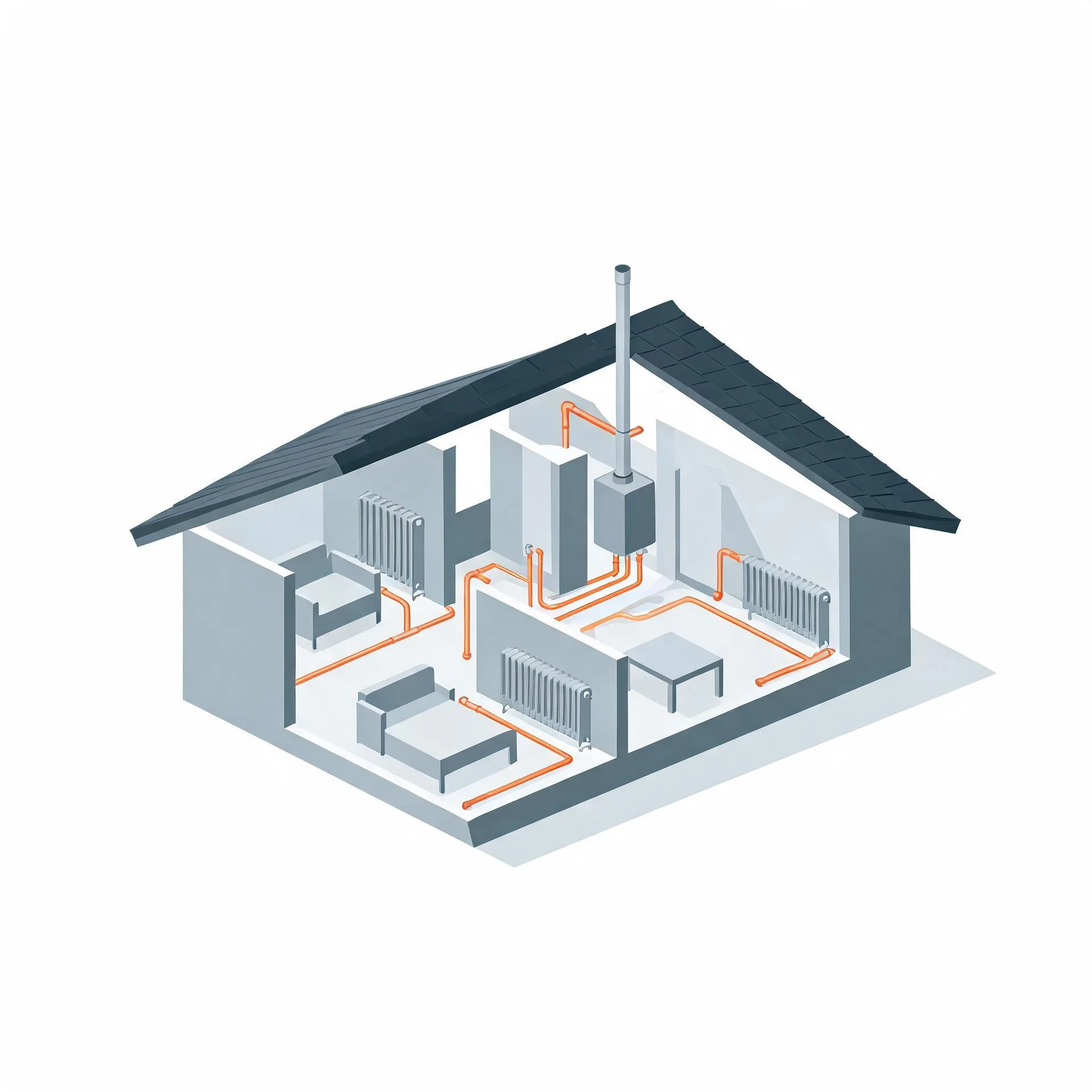
The boiler itself sits in a mechanical room, basement, or utility closet and is the unit a contractor installs first. It heats water and sends it out through the house. Paired with it is the expansion tank, which mounts nearby and absorbs pressure changes as the water heats and cools.
From the boiler, copper or PEX supply lines run through the house to the heat emitters, whether those are baseboard radiators along the walls or radiant loops set into the floor. A circulator pump, mounted directly on the boiler or on the supply piping, pushes the heated water through that circuit. The thermostat ties it all together, signaling the boiler when to fire.
The drawing shows a typical layout, and a licensed contractor determines exactly which components apply to your house and how they connect.
Get matched in Marion CountyMarion County, Kentucky, by the numbers
74 severe weather events were recorded in Marion County, Kentucky between 2015 and 2024.
NOAA National Centers for Environmental Information, Storm Events Database, bulk CSV export, events 2015-01-01 through 2024-12-31.Half the homes in Marion County, Kentucky were built in 1984 or earlier (2020-2024 ACS 5-year).
U.S. Census Bureau, 2020-2024 American Community Survey 5-Year EstimatesMarion County, Kentucky holds 8,477 housing units (2020-2024 ACS 5-year).
U.S. Census Bureau, 2020-2024 American Community Survey 5-Year EstimatesOwners occupy 77.7% of the occupied homes in Marion County, Kentucky (2020-2024 ACS 5-year).
U.S. Census Bureau, 2020-2024 American Community Survey 5-Year EstimatesBoiler Installation Rules for Marion County, Kentucky1 sourced codes and standards
Licensing Rules for HVAC Work in Marion County, Kentucky
Kentucky requires a licence to practise heating, ventilation and air conditioning contracting: a person may not do the work unless they have met the state licensing requirements.
Severe Weather Events in Marion County
Boilers work hardest when outdoor conditions push hardest against them. How much stress local weather puts on heating equipment is a Marion County question, not a national one.
74 severe weather events, 2015–2024. Source: NOAA National Centers for Environmental Information, Storm Events Database.